Is There Any Place in Tallahassee Fl to Buy Common Core Language Art Answer Keys
Introduction
As class sizes in education are increasing and engineering science is impacting on teaching at all levels, these trends create meaning challenges for teachers as they attempt to support individual students. Applied science undoubtedly provides substantial advantages for students, enabling them to access data from around the planet easily and at whatsoever time. The advantages and disadvantages of the increased use of engineering have come up to light over fourth dimension as students increasingly appoint with new innovations. In this review, we will address an result that has become progressively evident in digital learning environments but is relevant to all educational settings, particularly as class sizes grow. We volition explore the difficulties in attempting to understand and account for the struggles students experience while learning a item emphasis on what happens when students experience difficulties and go dislocated.
Running into problems while learning is frequently accompanied by an emotional response. Emotion, more broadly, plays a vital role in the integration of new noesis with prior noesis. This has been found to be the instance in brain imaging studies (e.1000., LeDoux, 1992), laboratory-based studies (e.g., Isen et al., 1987), and applied educational studies (east.g., Pekrun, 2005). A articulate example of how emotion can touch on the learning process is where it creates an obstacle to learning, reflected in, for example, the vast body of work that has examined the detrimental effect of anxiety on the learning of mathematics (Hembree, 1990). Similarly, confusion has been associated with blockages or impasses in the learning process (Kennedy and Order, 2016).
Despite its importance, understanding, identifying and responding to difficulties and the resulting emotions in learning can be problematic, particularly in larger classes and in digital environments. Without the affordances of synchronous face-to-face human interaction in digital environments, emotions like defoliation are hard to discover. It is therefore challenging to respond to students with back up or feedback to assistance their progress when they are stuck and become confused. Humans are uniquely tuned to respond to the emotional reactions of other humans (Damasio, 1994). Intuitively we know what information technology is like to feel confused as a upshot of a difficulty in the learning process, however defoliation is non regarded as ane of the "bones" emotions: like, for instance, happiness, sadness, and anger (Ekman, 2008). And while educatee confusion is relatively easy for an experienced instructor to detect in face-to-face settings (Lepper and Woolverton, 2002), it is a complex emotion that is difficult to explicate scientifically (Silvia, 2010; Pekrun and Stephens, 2011). But we know that confusion is both commonly felt past students, is able to be diagnosed by teachers, and able to be resolved productively with teacher support (run into for instance, Lehman et al., 2008). Thus, at the most fundamental level, confusion is both widely experienced and relatively easily detected by teachers, despite the uncertainty virtually the exact relationship between difficulties and emotional responses in learning. Thus, student emotions, such as confusion, are relatively straightforward for experienced teachers to detect, empathize and respond to in face-to-face settings with relatively modest course sizes (run into Woolfolk and Brooks, 1983; Woolf et al., 2009; Mainhard et al., 2018). The same is non true in digital environments or large classes. Emotions are less obvious to teachers when at that place are many students or when they collaborate with students via electronic methods (Wosnitza and Volet, 2005). This means that alternate practices are needed to respond to students when they experience difficulties in these emerging environments.
The increased difficulty in detecting and responding to educatee emotions is one of several cardinal reasons why a deeper understanding of difficulties and associated emotional responses is needed as new technologies and increasing class sizes impact education. Digital learning environments, especially online or distance learning environments, are often explicitly designed and so that students will have flexibility and autonomy in their studies. Students, when studying online or at a altitude, are often able to admission form material and resource in their own time (and place) and are often not constrained past centralized timetables. Equally a result, there is often a greater onus on students in these environments to be more autonomous and self-directed in their learning (Huang, 2002). Thus, increased learning flexibility ofttimes leads to students having fewer opportunities for engaging with teaching staff and receiving feedback in real time (Mansour and Mupinga, 2007). While activities can exist fabricated available in the form of webinars and other synchronous formats, in that location remains a substantial responsibleness on students to be autonomous and make adept decisions nearly their own progress without requiring the real-time intervention of pedagogy staff.
Digital learning environments that largely provide cocky-directed students with autonomy and flexibility can potentially be created to detect and respond to student difficulties, but this potential has non however been realized (Arguel et al., 2017). A key challenge for educational engineering science researchers and educators is to create digital environments that are better able to provide back up for and potentially respond to difficulties and the resulting emotions such every bit defoliation, without the requirement of having a teacher on-call to back up students. For this to occur, sophisticated digital learning environments need to be created that can back up students in their autonomous, personalized and self-directed learning and provide feedback that in some manner, emulates what a teacher does in more than traditional, face-to-confront settings.
In social club for a digital learning environment to be responsive to difficulties—or indeed to other emotions that touch on learning—it is necessary for the system to observe the emotions that students experience during their learning (Arguel et al., 2017). These emotional responses are the key indicator teachers utilise in face-to-face settings to make up one's mind when students are having problems. Given the difficulty of identifying emotions in digital learning environments in ways that humans can in face-to-face environments, this is a particularly vexing issue and one that has led to the growth of the burgeoning field of melancholia calculating (Picard, 2000). A second requirement is that digital learning environments demand to be reactive to emotional responses such as confusion once these responses take been detected. For example, it would be useful if dislocated learners were given arrangement-generated, programmed support to help them resolve their difficulties within the surroundings itself. Without a teacher present and without whatsoever automatic support, information technology is possible that a educatee may succumb to their defoliation, get frustrated and, as a issue, disengage entirely (D'Mello and Graesser, 2014). While it is difficult enough to determine when students become dislocated in these environments, information technology is even more complex to know when and how to intervene to prevent the confusion from condign boredom or frustration. Finally, it would be a singled-out reward if any response or feedback that a digital learning environment provided a confused student could be tailored and personalized to the private pupil and their learning pathway, progress and process (Lodge, 2018). Teachers are able to speedily adapt to an individual student'due south emotional responses in a classroom in smaller classes. This enables teachers to intervene with individualized, customized assistance and feedback for students, which tin help them manage both their emotions and their approach to the particular learning activity they are finding confusing. Effective intervention represents a pregnant challenge for designers of digital learning environments as teachers are proficient at responding to student emotions in nuanced and personalized ways that are not hands programmed into a digital system.
Taken together, it is apparent that the increased use of digital learning environments has created a demand for better agreement and intervening when students experience difficulties and go confused. This situation is, however, non helped by ongoing conjecture in the literature equally to whether difficulties in the learning process resulting in defoliation are detrimental or beneficial for learning (Arguel et al., 2017). For example, Dweck (1986) argues that defoliation is consistently detrimental to learning and is mediated past prior achievement, IQ scores, and conviction. She suggests that students who have poor prior achievement and confidence are at risk of attributing the experience of reaching a learning impasse and their resulting emotional response to their lack of bent. That is, students who become confused while completing a learning activeness may translate their confusion as a sign that they are incapable of learning the cloth. This argument aligns with a trunk of literature showing that persistent defoliation can lead to frustration and boredom, which as a issue has a negative bear on on learning (D'Mello and Graesser, 2014). More than recently, still, enquiry has suggested that difficulties resulting in confusion tin can do good pupil learning. This is peradventure best exemplified in the research on what have been labeled "desirable difficulties" (Bjork and Bjork, 2011), specific features of the learning state of affairs that introduce beneficial difficulties that reliably enhance learning. Along like lines, D'Mello et al. (2014) found that inducing difficulties and confusion in an intelligent tutoring organisation appeared to enhance learning. Moreover, some research has indicated that difficulties may be particularly beneficial for conceptual learning, where students sometimes need to overcome misconceptions earlier developing a more sophisticated understanding of the topic area (Kennedy and Lodge, 2016). For example, Chen et al. (2013) developed a predict-observe-explain activeness well-nigh commonly misconceived notions in electronics. Conflicting information was presented to students in the form of scenarios and the resulting confusion, when resolved, appeared to enhance student learning, specially in relation to correcting the misconceptions. What is apparent from this research is that there seems to be a complex mix of factors that pb to students experiencing difficulties and uncertainty well-nigh what kinds of outcomes occur as a result. The factors vary between students and the kinds of difficulties faced will differ across knowledge domains and task types.
From these few studies it is axiomatic that experiencing difficulties and confusion might be beneficial for different students under different circumstances and that the part of confusion in productive learning is important to empathize across dissimilar learning environments, noesis domains, and types of learning activities. Dweck's (1986) work indicates that confusion may be interpreted, managed and adapted to in different ways by students depending on their levels of confidence and past achievements. On the other hand, the piece of work of D'Mello et al. (2014) and Chen et al. (2013) suggests that confusion can help students' learning, particularly when conceptual learning or conceptual change is the aim of the activity.
In this integrative review, we examine the literature on difficulties in learning. We focus here on the ways in which it might exist possible to detect confusion experienced equally a upshot of difficulties and intervene when students are counterproductively confused. Our aim is to explore the ways in which the difficulties students experience in learning could exist harnessed for the purpose of enhancing their didactics. If digital learning environments are to reach their potential, they must be designed in a way to enable sophisticated back up and feedback to confused students, in ways that are similar to those a teacher can provide in small group contiguous settings.
Difficulties, Confusion, and Their Function in Learning
While confusion is common in educational practice and learning inquiry, by and large speaking, it has been poorly divers and understood in the educational literature (Silvia, 2010). Confusion is oft associated with reaching a cerebral impasse or "being stuck" while trying to learn something new (Woolf et al., 2009), and it is also normally regarded equally a negative emotional experience or something to be avoided while learning ("Miss, help me, I am dislocated!"; see also Kort et al., 2001). Both of these aspects of confusion—beingness stuck and a feeling to exist avoided—take perhaps led to the everyday notion that defoliation is detrimental to learning. While there is certainly research that suggests when defoliation persists to the point of frustration, it commonly leads to negative outcomes and has a detrimental affect on understanding (Dweck, 1986; D'Mello and Graesser, 2011), as mentioned above, in that location are times when information technology may be beneficial to feel a cerebral impasse and the feeling of defoliation when learning.
When it comes to defining what confusion actually is, there has been some ambiguity equally to the extent to which it is a cognitive or emotional phenomenon (D'Mello and Graesser, 2014). This uncertainty stems from debates most whether or not emotions such equally confusion require some element of interpretation in order for the subjective feel of the emotion to have form. These views are derived from an attributional perspective on emotion (Schachter and Vocalist, 1962). The procedure, according to this perspective, is that confusion is the effect of an individual'southward attribution of an affective response to a preceding subjective experience. In other words, the educatee reaches an impasse that causes them some difficulty. As a result of the impasse, the educatee has some sort of emotional response to the state of affairs they observe themselves in. That emotional response is then interpreted by the individual—they attribute significant to it—which may be confusion (or anxiety, or excitement). In this style, the individual experiences or "attributes" the emotion of confusion to the impasse. This estimation is particularly important given that confusion in learning needs to be well-nigh some educational textile attempting to be understood by a student (Silvia, 2010). However, the attributional process too suggests that there are substantial differences between individuals in terms of the attributions they make. Ii students can experience the exact same educational conditions and interpret them in vastly different means, leading one to be confused while the other experiences no such response. The interaction between subjective experience and content knowledge has led to defoliation existence defined equally an "epistemic emotion" (Pekrun and Stephens, 2011). In other words, defoliation can be divers every bit an melancholia response that occurs in relation to how people come to know or understand something. When defined equally an epistemic emotion, confusion is considered to have both cerebral and melancholia components.
While information technology is reasonably articulate that defoliation has both cerebral and affective components, what is less obvious is whether difficulties in learning that result in confusion are productive or unproductive in learning. The literature in this area is somewhat equivocal. D'Mello et al. (2014) examined students when learning about scientific reasoning using an intelligent tutoring organization. By inducing confusion through the presentation of contradictory information, they were able to determine whether the experience of being dislocated contributed negatively or positively to learning outcomes. Ii virtual agents were used in the intelligent tutoring arrangement to present information about the topic. In the confusion condition, the information from the two agents was contradictory and thus confusing for students. D'Mello and colleagues constitute that when students completed the "confused" (i.due east., contradictory) status compared to when they completed the control (i.e., not-contradictory) condition they showed enhanced operation, and equally a consequence, argued that defoliation can be beneficial for learning. What remains unclear though is whether it was the difficulty, the subjective experience of confusion or a mixture of both that was responsible for the observed differences between the groups.
Numerous attempts take been made to induce difficulties and confusion during learning to determine nether what conditions information technology contributes productively to student learning outcomes (e.g., Lee et al., 2011; Lehman et al., 2013; Andres et al., 2014; Social club and Kennedy, 2015). For case, Grawemeyer et al. (2015) examined students' confusion (and other emotions) during an action in a digital learning environment that focussed on fractions. They found that, when provided with the appropriate support at the correct fourth dimension, in the form of feedback and teaching, the difficulties experienced by students led to enhanced learning. Similarly, Muller et al. (2007) considered how videos including the presentation and subsequent correction (refutation) of a misconceived notion could create student confusion compared to videos which used more than traditional didactic presentation methods. Students who watched physics videos using the refutation method were exposed to the most confusing aspects of the concepts at the beginning of the video followed by an caption of the normally misconceived aspects of the content. Despite their college levels of reported confusion, students in the refutation status showed greater cognition gains compared to students who watched the more traditional videos. Muller and his colleagues argued that these findings are related to the actress mental effort expended in trying to understand the material when information technology is disruptive.
These findings, and particularly Muller et al.'southward (2007) interpretation of their results, suggests that, when students experience difficulties and confusion, it may in fact serve as a trigger to aid them overcome any conceptual obstacles they come across during their learning. Along similar lines, Ohlsson (2011) argues that impasses and difficulties experienced in the learning process could be effective triggers for students to rethink their learning approaches. When students accomplish a conceptual impasse, this may serve as a cue that their electric current strategy or approach to the learning cloth is not effective, leading them to consider alternate strategies (D'Mello and Graesser, 2012). This perspective is consistent with inquiry that has considered students' strategies for dealing with challenging material. In a series of experimental studies, Alter et al. (2007) found that, when difficulties are introduced while people acquire and reason about new information, information technology triggers a shift in strategy, activating a more systematic or analytic arroyo to the material. It may be, therefore, that difficulties encountered during the learning process that are accompanied by a subjective feeling of defoliation can lead students to alter their learning strategies which may resolve the impasse, resulting in learning benefits. What this research and the findings advise, withal, is that students need to be able to place the trigger as a cue to modify strategy, which necessitates a capacity for monitoring and self-regulation.
Findings from other studies have found that defoliation-inducing difficulties are not a productive office of the learning process despite the empirical research supporting the notion that confusion is beneficial in students' learning. For example, Andres et al. (2014) examined confusion while students engaged with a problem solving-based video game designed to help them learn about physics. In this report, defoliation negatively impacted on students' ability to solve the problems and, compared to students who were less confused, dislocated students were less likely to chief the learning material. A second study, Poehnl and Bogner (2013), presented alternative scientific conceptions to a large group of ninth form students. Despite the apparently higher levels of confusion in this group compared to a group who were non exposed to the confusion-inducing alternating conceptions, this grouping performed worse in terms of the overall number of conceptions learned. As such, there is conflicting evidence about what role difficulties and resulting confusion play in learning nether different conditions. Given the possibility that defoliation may operate equally a trigger for action. This over again highlights the possible part of self-regulation in this process. Year 9 students in the Poehnl and Bogner written report may not accept the same capacity to self-regulate their learning every bit university students in the other studies discussed here.
Peradventure surprisingly, these are among the few empirical investigations to directly consider the touch on of confusion on students' learning that accept found it has a deleterious result and those that have often involve younger students. Even so, research from other areas of learning and education, while not directly considering the office of confusion in learning, take provided findings that are relevant to the role that difficulties and confusion may play in students' learning. The important distinction seems to be the divergence between difficulties that students experience and the emotions that they experience as a result of these difficulties. While there has been express research examining students' experiences of confusion, there has been much work done on trying to understand the role of difficulties in the learning process. For this review, nosotros scanned the literature in educational psychology, experimental psychology, and education to wait for concepts that share a family resemblance (as per Wittgenstein, 1968) to the enquiry on difficulties and confusion.
Inquiry on Learning Challenges and Difficulties
Prominent among similar bodies of work that may assist in understanding how difficulties might contribute to learning in digital environments is research in areas such as desirable difficulties (due east.g., Bjork and Bjork, 2011), productive failure (e.g., Kapur, 2008), impasse-driven learning (eastward.g., VanLehn, 1988), cognitive disequilibrium (east.g., Graesser et al., 2005), and investigations of learning in discovery-based environments (due east.g., Moreno, 2004; Alfieri et al., 2011). Information technology is amongst these cognate fields of enquiry that nosotros may discover farther prove to support the processes that atomic number 82 to defoliation being benign (or not) for learning. Our aim in attempting to compare and contrast this literature is to better understand how difficulties and defoliation may be beneficial to learning and nether what weather condition.
Studies of desirable difficulties typically consider how aspects of the learning process can encumber learners, and how this process (or "difficulty") can lead to enhanced learning compared to learners not exposed to the difficulty (Bjork and Bjork, 2011). For case, Sungkhasettee et al. (2011) asked participants to study lists of words either upright or inverted. When learning the inverted words, participants demonstrated superior recall to conditions where the words were presented upright. In a similar written report using more educationally relevant material, Adams et al. (2013) reported on a series of studies where erroneous examples were given to students who were learning mathematics in a digital environment. Across these studies, Adams et al. found that the employ of erroneous examples in mathematics instruction led to improvements in learning consistent with those observed in the broader literature on desirable difficulties. In order to describe the mechanism by which difficulties enhance learning, Adams et al., argue that the use of wrong examples encourages students to process the learning material in a unlike way, which leads to amend retentivity and transfer of their understanding. They suggest that students, by considering and engaging in alternative trouble solutions, process fabric more deeply and this is thought to exist responsible for the enhanced learning observed (encounter also McDaniel and Butler, 2011).
The growing body of research on desirable difficulties has raised some questions about what constitutes a beneficial difficulty in the learning process (Yue et al., 2013). For instance, in a widely cited study, Diemand-Yauman et al. (2011) presented fabric to participants (study 1) and students (report 2) in easy and hard to read fonts. They found that participants and students who studied material in hard to read fonts performed better when later quizzed on the material. The authors hypothesized that the difficulty in reading the disfluent font slowed the learning process down, leading to deeper encoding, thus creating a desirable difficulty. Subsequent attempts to replicate this disfluency-based desirable difficulty accept failed (e.g., Rummer et al., 2016), creating further dubiety most what constitutes a desirable difficulty. Whatever the purlieus atmospheric condition of desirable difficulties, it is apparent that sure kinds of difficulties in the learning process tin reliably enhance the encoding, storage and retrieval of data. Participants exposed to desirable difficulties in the majority of the research on these effects to date take done and so predominantly under laboratory weather. However, it is apparent that there were substantial advantages to introducing targeted difficulties in the learning procedure that are strong candidates for enhancing learning in alive educational settings (Yan et al., 2017) and for farther explaining how difficulties contribute to quality learning more than broadly.
The principle of productive failure provides another possibility for framing the apply of difficulties to enhance learning. Productive failure is a way of sequencing learning activities to give students an opportunity to familiarize themselves with a circuitous trouble or issue in a structured environment but without meaning instruction on the content of the textile to be learned (Kapur, 2015). Kapur (2014) tested groups of students who were given an opportunity to solve mathematics bug either before or later on being given explicit instruction on the procedure associated with how to solve the issues. He establish that the group of students who were given the opportunity to endeavor issues before existence given explicit instructions, despite ofttimes declining in their commencement attempts, overall demonstrated significantly greater gains in learning compared to students who received instructions prior to attempting to solve problems. Without necessarily having the requisite skills or information to solve the bug they were presented with, students would often attain an impasse in the learning procedure. Kapur (2015) argued that the impasse reached through the failed attempts at learning helps students generate more and unlike trouble-solving strategies through a process that enhances learning over both the shorter and the longer term. It should exist noted here that the tasks used in productive failure studies are different to those used in studies of desirable difficulties. Studies on productive failure tend to employ more realistic problems given to students rather than tasks that rely more than on memorisation.
Despite the different kinds of tasks used, there are clear parallels between the "failure" aspect of productive failure, and the "difficulties" encountered by students within a desirable difficulty paradigm (Kapur and Bielaczyc, 2012). In both situations, there is a deliberate strategy to encumber students' learning process and potentially trigger confusion. Dissimilar the piece of work on desirable difficulties, however, much of the research on productive failure has been carried out in naturalistic educational settings. This is achieved partly through the sequencing of the activity. The lack of direct instruction on the problem or issue often leads students to inevitably accomplish an impasse in the learning process that is seemingly accompanied past a sense of defoliation (Hung et al., 2009). Equally summarized by Kapur (2015), the benefits of productive failure have been demonstrated many times in the peer-reviewed literature (east.g., Kapur, 2008; Kapur and Rummel, 2012). The results of these studies demonstrate that when students appoint in some trouble solving first followed past just-in-time instruction when they reach an impasse (i.due east., the process leads to failure), it leads to enhanced learning in educational situations that are designed to rely on direct educational activity.
Productive failure shares some similarity with the notion of impasse-driven learning, which focuses on what happens when students reach a blockage in their learning. VanLehn (1988) suggests that when students reach an impasse in the learning procedure, information technology forces them to go into a problem-solving strategy he labeled "repair." In other words, students engage in a metacognitive process whereby they attempt to use trouble-solving strategies to overcome the impasse or seek aid. In both cases, the necessity of engaging in "meta-level" thinking is hypothesized to lead to more effective learning. This notion is like to the argument made by Ohlsson (2011) in relation to strategy shifting and once again highlights the importance of a chapters to monitor and self-regulate learning. In a test of impasse-driven learning, Blumberg et al. (2008) examined frequent and exceptional players of video games and asked them to describe their experiences as they worked through a novel video game. They constitute that participants who engaged in video games regularly were more able to describe their problem-solving strategies and moments of insight than those infrequently exposed to the types of impasses institute in the games. To examine how this process applies to tutoring, VanLehn et al. (2003) analyzed dialogue in tutoring sessions on physics. Their results suggested that students were receptive to tutoring particularly when they reached an impasse in the learning procedure compared to when they were not at an impasse. The research on impasse-driven learning over again suggests that there is something critical about the metacognitive, learning or study strategies that students appoint in when their learning process is disrupted or challenged in some way.
At the core of desirable difficulties, productive failure and impasse driven learning is the notion that a difficulty or deliberately designed challenges are of import for learning (VanLehn, 1988; Ohlsson, 2011). Gimmicky, and increasingly popular models of didactics, rooted in Bruner's (1961) notion of discovery-based learning likewise share this feature. Discovery-based models of teaching and learning such as problem-based learning typically nowadays students with an ill-structured scenario, situation or trouble, which they discuss, often in groups, and investigate in guild to resolve. Students, in discussing the problem among themselves with or without a more skillful facilitator, inevitably encounter material that they do not empathise, that is confusing, and represents an impasse in their investigation of the problem. These impasses are key to the problem-based learning instructional model as they both drive the learning process (becoming the "learning problems" that guide students' learning and guide their investigations of the problem) and they likewise are said to act as intrinsic motivators for students as they effort to resolve the problem (Schmidt, 1993).
Given some of the core similarities betwixt these theoretical models,—productive failure, impasse driven learning, desirable difficulties, and problem-based learning—a primal question for educational researchers is: what are the underlying cognitive and learning processes that both bring virtually student confusion, and underpin the potential learning benefits derived from it? Also, how do these processes differ between individual students, learning different textile, and engaged in different types of tasks? Graesser and D'Mello (2012) suggest that the prime number candidate for this underpinning process is cognitive disequilibrium. The notion of cognitive disequilibrium is derived from Piaget's piece of work on cerebral evolution (Piaget, 1964). It occurs when there is an imbalance created when new information does not seamlessly integrate with existing mental schema. It is plausible and so that confusion is the consequence of certain types of difficulties in the learning process, namely those that lead to an impasse underpinned past cognitive disequilibrium. In attempting to design for and provide interventions for productive challenges then, what appears to exist of import is not the introduction of difficulties per se just the introduction of difficulties that atomic number 82 to an impasse and a sense of disequilibrium. Based on the research across these domains this, in plough, is hypothesized to lead to a modify in learning arroyo or problem-solving strategy that can enhance learning.
A Framework for Understanding and Seeing Difficulties and Resulting Confusion in Learning
From this review, information technology seems clear that difficulties experienced during learning and resulting in confusion can be either productive or unproductive depending on the arrangement of and relationship between a range of variables within a learning environment. These include the type of learning activeness, the knowledge domain being learned, and individual differences such as how students attribute difficulties and their capacity for self-regulated learning. For any particular learning or content area, the degree to which difficulties are experienced by a learner, and whether the experience of the resulting epistemic emotion will be productive or unproductive, is a result of a complex relationship betwixt:
(i) Individually-based variables, such every bit prior noesis, self-efficacy, and self-regulation;
(ii) The sequence, structure and design of learning tasks and activities; and
(iii) The design and timeliness feedback, guidance, and support provided to students during the learning activeness or job.
A key challenge for educational researchers is to determine what sets of relationships between what variables lead to adaptive and maladaptive learning processes and outcomes in digital learning environments.
The review of the literature besides suggests two learning processes could exist promoted when students experience defoliation: 1 general and one specific. The first, more general, process is that difficulties encourage students to invest more "mental effort" in their learning; they somehow work harder cognitively—through attention or concentration—to resolve the conceptual impasse and the confusion that has resulted from it. The second is that students, when piqued by a conceptual impasse and the resulting feelings of defoliation, actively generate and prefer culling approaches to the learning material they are seeking to understand. This 2nd process suggests that students do not merely invest a greater attempt in their learning; it suggests that they investigate and adopt alternative study approaches and strategies, which they then utilize. In society for this 2nd process to occur, students need to be sufficiently able to monitor their progress and empathize how to take activity on the basis of their experience of difficulty or the reaching of an impasse.
Finally, this review suggests that insurmountable learning difficulties may ascend when students experience too much defoliation or when confusion persists for too long. Every bit discussed past D'Mello and Graesser (2014) one of the most important factors in the benign event of confusion is that it is resolved. Unresolved, persistent confusion leads to frustration, boredom and therefore is detrimental for learning. In an example of this delicate rest in action, Lee et al. (2011) examined confusion while novices attempted to larn how to write computer code. They establish that overcoming confusion can heighten learning but, when information technology remains unresolved, it leads to deleterious effects on student accomplishment. This ascertainment speaks to the importance of addressing student defoliation in a timely and personalized way. However, given the complexities introduced by the individual differences between students, this is not a straightforward chore.
In many ways, these features of defoliation are captured in Graesser'southward (2011) notion of a "zone of optimal confusion" (ZOC). Reminiscent of Vygotsky'southward (1978) concept of the zone of proximal evolution, the ZOC suggests that it is important not to have as well footling or also much difficulty simply to aim to have just the correct amount. If educators and educational designers aimed to create challenges and induce a alter in learning strategy as a deliberate tactic to promote conceptual change, students would need to experience sufficient subjective difficulty for the impasse in the learning process to be experienced as confusion. However, if too much or persistent defoliation is experienced, it will lead to frustration, hopelessness, boredom and giving upwardly. To apply difficulties as a deliberate instructional strategy in digital learning environments is, therefore, a double-edged sword. If students are non sufficiently engaged to become confused and redress their way of budgeted the action, they tin can then become bored and potentially regress dorsum to their initial conception. If students can exist guided and supported through their defoliation, however, it can then atomic number 82 to the productive learning outcomes reported in the empirical literature. That, in essence, is the ZOC.
One ongoing outcome with the notion of "optimal defoliation" is that it is difficult to determine what separates productive from non-productive defoliation every bit learning unfolds. Given the complexities involved due to individual responses to difficulties in learning, the threshold at which constructive confusion becomes non-productive frustration or boredom will differ markedly between individuals (Kennedy and Society, 2016). Identifying where a educatee might be along the confusion continuum in advance of knowing the outcome of the learning activity is a significant challenge. Kennedy and Order plant that in that location were markers evident in trace data suggestive of students crossing the threshold into unproductive forms of defoliation. For example, extended delays in progress observed as significant time lags betwixt interactions or rapid cycling through activities are possible indicators of colorlessness or frustration respectively. Inferring in real time whether students are experiencing confusion that is productive or unproductive remains a challenge but there is some emerging evidence that information and analytics could be used to help predict how students are tracking and provide feedback and back up contained of knowing the issue (Arguel et al., 2019).
Based on Graesser's (2011) "ZOC" and, using cognitive disequilibrium as a framing mechanism for the important role of confusion in learning, nosotros propose a framework for defoliation in digital learning environments (see Effigy 1). From the pinnacle of Figure 1, a learning effect tin can be specifically designed to create cognitive disequilibrium. An example of this is the approach used by Muller et al. (2008) to create disequilibrium in videos. In this report, the researchers created disequilibrium by focussing on misconceptions as a core instructional strategy, the disequilibrium being generated through the altitude betwixt what people think they know and the accepted scientific understanding. From there, disequilibrium is generated equally a crusade of an impasse in the learning procedure. At this stage, students will move into the ZOC and so long as they are sufficiently engaged and aspect the impasse to be confusing. If this occurs in a productive style and the student has sufficient metacognitive sensation and skill to recognize the confusion every bit a cue to alter strategy, the disequilibrium volition exist effectively resolved, conceptual change will occur, and students volition move on to some other learning issue. If the defoliation becomes persistent, on the other manus, so students may possibly motion into the zone of sub-optimal defoliation (ZOSOC). When this occurs, the defoliation becomes unproductive and leads to possible frustration and/or colorlessness. Over again, it is difficult to determine in real fourth dimension when and how this occurs and that remains a challenge for time to come inquiry to examine. The model proposed here builds on like previous work by D'Mello and Graesser (2014) but is particularly focused on further elucidating both the underpinning processes and the characteristics of the learning design that might influence both the initiation of confusion and its resolution.
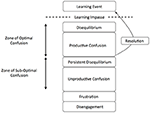
Figure one. Conceptual framework for the zones of optimal and sub-optimal confusion.
Implications of the Framework
If it can be assumed that defoliation is beneficial for learning nether some circumstances then it is worth because the implications of this for learning design. The creation of disequilibrium and defoliation is of import to both engage students and create the incertitude required to help them develop conceptual knowledge. A learning outcome that is aimed at creating this disequilibrium will need to be designed with the aim of both getting students into the ZOC and making sure that they practice not enter the ZOSOC. Enticing students to enter the ZOC has been achieved in numerous ways as described above. For example, the fabric presented or the medium through which it is presented can be contradictory, counterintuitive or the environment can accept little to no guidance equally in pure discovery-based learning and, to a lesser extent, productive failure. Taken together, there would announced to be many means to lure students into the ZOC. That said, there are no guarantees that students volition enter this ZOC. If a student has loftier levels of prior knowledge or is highly confident, for instance, they may persist at a task with renewed vigor rather than attribute an impasse as confusing (Arguel et al., 2016).
When it does occur, ensuring the confusion leads to a productive consequence is more challenging as it requires the students themselves resolving the disequilibrium, a timely intervention from a instructor, or in a way that can exist automatically supported in a digital learning surroundings. Thus, there appear to be 2 broad options for ensuring defoliation leads to productive outcomes. Every bit alluded to to a higher place, the development of effective self-regulation in learning is one way of ensuring that students move from being confused to effectively learning. While students' skills in cocky-regulation are something they may at least partly bring to a learning event, at that place is likewise potential for building in interventions to assist with cocky-regulation into the learning environment (Social club et al., 2018). For instance, if students did change their strategy or approach to a learning event, this creates an opportunity for them to reflect on the modify in their approach and consider how such a strategy might exist useful in time to come learning situations. So, while there are opportunities for helping students to effectively learn new material, there are also possibilities in these situations for students to consider the strategies they use when learning more broadly. In a very concrete fashion, one intervention strategy is to help students to understand that difficulties and confusion every bit part of the learning procedure are perfectly normal and, indeed, necessary in many instances. Helping students to see confusion equally a cue to effort a unlike approach rather than see it is a sign that they are incapable would be a uncomplicated fashion to amend students' chapters to deal with hard and confusing elements of learning.
A second option for ensuring that students effectively pass through the ZOC and achieve productive learning outcomes is to apply feedback. Feedback tin accept many different forms in digital learning environments thus providing many options for intervening when students appear to be confused. The critical aspect of any intervention on confusion to avert having students enter into the ZOSOC will be to personalize that feedback by taking into account their prior knowledge (Lehman et al., 2012). Intelligent tutoring systems have some chapters for this level of personalisation. However, much remains to be done before these systems can be regarded every bit existence truly adaptive to the affective components of student learning and applied at calibration (Baker, 2016). Every bit a proof of concept though, there are examples of sophisticated adaptive systems that have been built to provide real time feedback and prompts based on student performance as they progress through procedural tasks. For example, adaptive systems have long been bachelor to provide data-driven feedback and prompts to trainee surgeons (Piromchai et al., 2017), and dentists (Perry et al., 2015). That it is possible to create systems that can apply data about pupil interaction to inform feedback interventions suggest that it is possible to build systems that will work beyond different knowledge domains to answer to students having difficulties.
In the interim, while intelligent tutoring and other adaptive systems built on machine learning and artificial intelligence mature, there are possibilities for edifice digital learning environments to cater for difficulties and resulting confusion. Most prominent among these are the development of sophisticated learning designs that can respond to student confusion through enhancing student self-regulation and providing feedback in the form of hints or formative information most the strategies or approaches existence used. That is not to say that the development of such systems will be easy. Part of the approach to helping students become better equipped to bargain with difficulties and confusion needs to be to address the notion that difficulties are inherently detrimental and an indicator that students are non capable.
Determination
Difficulties and the confusion that often results are difficult to detect, manage, and reply to in digital learning environments and large classes compared to smaller grouping face-to-confront settings. Despite this, in this paper we accept argued that difficulties and defoliation are of import in the process of learning, particularly when students are developing more sophisticated understandings of complex concepts. Piece of work on desirable difficulties, impasse driven learning, productive failure, and pure discovery-based learning all provide clues as to how confusion could be beneficial for learning. The cosmos of a sense of cognitive disequilibrium appears to be a vital chemical element and the defoliation needs to exist effectively resolved by helping students pass through the ZOC without them entering the ZOSOC. We take attempted here to provide a conceptual model for the procedure by which students pass through this optimal zone. Our hope is that this will help to outline the procedure of the development and resolution of confusion so that researchers and learning designers can proceed to develop methods for ensuring students reach productive outcomes as a result of condign dislocated.
Author Contributions
JL, GK, LL, AA, and MP contributed to the conceptualization, research, and writing of this commodity.
Funding
The authors of this review received funding from the Australian Research Quango for the work in this review as part of a Special Enquiry Initiative (Grant number: SRI20300015).
Conflict of Interest Statement
The authors declare that the research was conducted in the absenteeism of any commercial or financial relationships that could exist construed as a potential conflict of interest.
Acknowledgments
The authors acknowledge the contributions of Dr. Paula de Barba toward this projection.
References
Adams, D. M., McLaren, B. One thousand., Mayer, R. Eastward., Goduadze, Yard., and Isotani, South. (2013). Erroneous examples every bit desirable difficulty. Artif. Int. Educ. Conf. Proc. 2013, 803–806. doi: ten.1007/978-three-642-39112-5_117
CrossRef Total Text | Google Scholar
Alfieri, L., Brooks, P. J., Aldrich, Northward. J., and Tenenbaum, H. R. (2011). Does discovery-based education enhance learning? J. Educ. Psychol. 103, 1–18. doi: ten.1037/a0021017
CrossRef Total Text | Google Scholar
Change, A. L., Oppenheimer, D. M., Epley, N., and Eyre, R. N. (2007). Overcoming intuition: metacognitive difficulty activates analytic reasoning. J. Exp. Psychol. Gen. 136, 569–576. doi: 10.1037/0096-3445.136.iv.569
PubMed Abstruse | CrossRef Full Text | Google Scholar
Andres, J., Rodrigo, M., and Sugay, J. O. (2014). "An exploratory assay of confusion among students using Newton's playground," in Proceedings of the 22nd International Conference on Computers in Education (Nara: Asia-Pacific Lodge for Computers in Education).
Google Scholar
Arguel, A., Lockyer, Fifty., Lipp, O. Five., Lodge, J. M., and Kennedy, G. (2017). Inside out: detecting learners' confusion to improve interactive digital learning environments. J. Educ. Comp. Res. 55, 526–551. doi: ten.1177/0735633116674732
CrossRef Full Text | Google Scholar
Arguel, A., Lodge, J. 1000., Pachman, K., and de Barba, P. (2016). "Confidence drives exploration strategies in interactive simulations," in Show Me the Learning. Proceedings ASCILITE 2016, eds S. Barker, Southward. Dawson, A. Pardo, and C. Colvin (Adelaide, SA), 33–42.
Google Scholar
Arguel, A., Pachman, M., and Lockyer, L. (2019). "Identifying epistemic emotions from activity analytics in interactive digital learning environments," in Learning Analytics in the Classroom: Translating Learning Analytics Research for Teachers, eds J. M. Lodge, J. C. Horvath, and L. Corrin (Abingdon: Routledge), 71–77.
Bakery, R. S. (2016). Stupid tutoring systems, intelligent humans. Int. J. Artif. Intel. Educ. doi: 10.1007/s40593-016-0105-0
CrossRef Full Text | Google Scholar
Bjork, E. L., and Bjork, R. A. (2011). "Making things hard on yourself, but in a practiced way: creating desirable difficulties to enhance learning," in Psychology and the Real World: Essays Illustrating Primal Contributions to Order, eds Thou. A. Gernsbacher, R. W. Pew, L. G. Hough, and J. R. Pomerantz (New York, NY: Worth), 56–64.
Google Scholar
Blumberg, F. C., Rosenthal, S. F., and Randall, J. D. (2008). Impasse-driven learning in the context of video games. Comp. Hum. Behav. 24, 1530–1541. doi: 10.1016/j.chb.2007.05.010
CrossRef Full Text | Google Scholar
Bruner, J. S. (1961). The human action of discovery. Harv. Educ. Rev. 31, 21–32.
Google Scholar
Chen, Y. L., Pan, P. R., Sung, Y. T., and Chang, M. E. (2013). Correcting misconceptions on electronics: Furnishings of a simulation-based learning environment backed by a conceptual change model. J. Educ. Technol. Soc. 16, 212–227.
Google Scholar
D'Mello, Southward., and Graesser, A. (2012). Dynamics of affective states during complex learning. Learn. Instru. 22, 145–157. doi: x.1016/j.learninstruc.2011.10.001
CrossRef Full Text | Google Scholar
D'Mello, S., Lehman, B., Pekrun, R., and Graesser, A. (2014). Confusion can be beneficial for learning. Learn. Instru. 29, 153–170. doi: 10.1016/j.learninstruc.2012.05.003
CrossRef Full Text | Google Scholar
Damasio, A. (1994). Descartes' Mistake. New York, NY: M.P Putnam'south Sons.
Diemand-Yauman, C., Oppenheimer, D. Grand., and Vaughan, E. B. (2011). Fortune favors the bold (and the italicized): effects of disfluency on educational outcomes. Cognition 118, 114–118. doi: 10.1016/j.noesis.2010.09.012
PubMed Abstract | CrossRef Total Text
D'Mello, S., and Graesser, A. (2014). "Confusion," in Handbook of Emotions and Teaching eds R. Pekrun and L. Linnenbrink-Garcia (New York, NY: Routledge), 289–310.
Google Scholar
Dweck, C. S. (1986). Motivational processes affecting learning. Am. Psychol. 41, 1040–1048. doi: 10.1037/0003-066XX.41.x.1040
CrossRef Total Text | Google Scholar
Ekman, P. (2008). An argument for bones emotions. Cognit. Emot. vi, 169–200. doi: 10.1080/02699939208411068
CrossRef Full Text
Graesser, A. C., and D'Mello, S. (2012). Emotions during the learning of hard fabric. Learn. Motivat. 57, 183–225. doi: ten.1016/B978-0-12-394293-7.00005-4
CrossRef Total Text | Google Scholar
Graesser, A. C., Lu, S., Olde, B. A., Cooper-Pye, E., and Whitten, S. (2005). Question asking and center tracking during cognitive disequilibrium: Comprehending illustrated texts on devices when the devices break downward. Mem. Cognit. 33, 1235–1247. doi: 10.3758/BF03193225
PubMed Abstruse | CrossRef Full Text | Google Scholar
Grawemeyer, B., Mavrikis, M., Holmes, Due west., Hansen, A., Loibl, Yard., and Gutierrez-Santos, South. (2015). Affect matters: exploring the impact of feedback during mathematical tasks in an exploratory environment. Artif. Intell. Educ. Conf. Proc. 2015, 595–599. doi: ten.1007/978-3-319-19773-9_70
CrossRef Full Text | Google Scholar
Hembree, R. (1990). The nature, effects, and relief of mathematics anxiety. J. Res. Mathe. Educ. 21, 33–46. doi: 10.2307/749455
CrossRef Full Text | Google Scholar
Huang, H. Yard. (2002). Toward constructivism for developed learners in online learning environments. Br. J. Educ. Technol. 33, 27–37. doi: 10.1111/1467-8535.00236
CrossRef Full Text | Google Scholar
Hung, D., Chen, V., and Lim, S. H. (2009). Unpacking the hidden efficacies of learning in productive failure. Learn. Inqu. 3, one–xix. doi: 10.1007/s11519-008-0037-1
CrossRef Total Text | Google Scholar
Kapur, M., and Bielaczyc, K. (2012). Designing for productive failure. J. Larn. Sci. 21, 45–83. doi: 10.1080/10508406.2011.591717
CrossRef Full Text | Google Scholar
Kapur, G., and Rummel, N. (2012). Productive failure in learning from generation and invention activities. Instruc. Sci. 40, 645–650. doi: 10.1007/s11251-012-9235-iv
CrossRef Full Text | Google Scholar
Kennedy, G., and Gild, J. M. (2016). "All roads lead to Rome: Tracking students' touch on equally they overcome misconceptions," in Bear witness Me the Learning. Proceedings ASCILITE 2016, eds Southward. Barker, S. Dawson, A. Pardo, and C. Colvin (Adelaide, SA), 318–328.
Google Scholar
Kort, B., Reilly, R., and Picard, R. (2001). "An affective model of interplay between emotions and learning: reengineering educational didactics—edifice a learning companion," in Proceedings of the IEEE International Briefing on Advanced Learning Technology: Issues, Achievements and Challenges, eds T. Okamoto, R. Hartley, kinshuk, and J. P. Klus (Madison, WI), 43–48.
Google Scholar
Lee, D., Rodrigo, Yard., Bakery, R. D., Sugay, J. O., and Coronel, A. (2011). "Exploring the human relationship betwixt novice programmer confusion and achievement," in International Conference on Melancholia Computing and Intelligent Interaction (Berlin: Springer), 175–184.
Google Scholar
Lehman, B., D'Mello, S., and Graesser, A. (2012). Confusion and circuitous learning during interactions with figurer learning environments. Inter. Higher Educ. 15, 184–194. doi: x.1016/j.iheduc.2012.01.002
CrossRef Full Text | Google Scholar
Lehman, B., D'Mello, S., and Graesser, A. (2013). "Who benefits from confusion consecration during learning? An individual differences cluster analysis," in Proceedings of 16th International Conference on Artificial Intelligence in Education, eds Grand. Yacef, C. Lane, J. Mostow, and P. Pavlik (Berlin: Springer), 51–60.
Google Scholar
Lehman, B., Matthews, M., D'Mello, S., and Person, Due north. (2008). "What are y'all feeling? Investigating student affective states during expert human tutoring sessions," in Intelligent Tutoring Systems, Vol. 5091 (Berlin: Springer), 50–59.
Google Scholar
Lepper, M. R., and Woolverton, M. (2002). "The wisdom of practice: Lessons learned from the study of highly effective tutors," in Improving Bookish Achievement: Contributions of Social Psychology, ed J. Aronson (Orlando, FL: Academic Press), 135–158.
Google Scholar
Gild, J. G. (2018). "A futures perspective on it and assessment," in International Handbook of Information Engineering science in Chief and Secondary Education 2nd Edn, eds J. Voogt, G. Knezek, R. Christensen, and K. Westward. Lai (Berlin: Springer), 1–thirteen.
Google Scholar
Lodge, J. M., and Kennedy, 1000. (2015). "Prior knowledge, confidence and understanding in interactive tutorials and simulations," in Globally Continued, Digitally Enabled, Proceedings Ascilite 2015 in Perth, eds T. Reiners, B. R. von Konsky, D. Gibson, 5. Chang, L. Irving, and M. Clarke (Tugan, QLD: ASCILITE), 178–188.
Google Scholar
Guild, J. M., Kennedy, Grand., and Hattie, J. A. C. (2018). "Agreement, assessing and enhancing student evaluative judgement in digital environments,' in Developing Evaluative Judgement in Higher Education: Assessment for Knowing and Producing Quality Work, eds D. Boud, R. Ajjawi, P. Dawson, and J. Tai (Abingdon: Routledge), 70–78.
Google Scholar
Mainhard, T., Oudman, S., Hornstra, L., Bosker, R. J., and Goetz, T. (2018). Student emotions in class: the relative importance of teachers and their interpersonal relations with students. Learn. Instruc. 53, 109–119. doi: ten.1016/j.learninstruc.2017.07.011
CrossRef Full Text | Google Scholar
Mansour, B. E., and Mupinga, D. Yard. (2007). Students' positive and negative experiences in hybrid and online classes. Coll. Stud. J. 41, 242–248.
Google Scholar
McDaniel, G. A., and Butler, A. C. (2011). "A contextual framework for understanding when difficulties are desirable," in Successful Remembering and Successful Forgetting: A Festschrift in Honor of Robert A. Bjork, ed A. S. Benjamin (New York, NY: Psychology Press), 175–198.
Google Scholar
Moreno, R. (2004). Decreasing cerebral load for novice students: effects of explanatory versus corrective feedback in discovery-based multimedia. Instruc. Sci. 32, 99–113. doi: ten.1023/B:TRUC.0000021811.66966.1d
CrossRef Full Text | Google Scholar
Muller, D. A., Bewes, J., Sharma, M. D., and Reimann, P. (2007). Saying the wrong affair: improving learning with multimedia by including misconceptions. J. Comp. Assis. Larn. 24, 144–155. doi: 10.1111/j.1365-2729.2007.00248.x
CrossRef Full Text | Google Scholar
Muller, D. A., Sharma, M. D., and Reimann, P. (2008). Raising cognitive load with linear multimedia to promote conceptual modify. Sci. Educ. 92, 278–296. doi: 10.1002/sce.20244
CrossRef Full Text | Google Scholar
Pekrun, R. (2005). Progress and open up problems in educational emotion inquiry. Larn. Instruc. 15, 497–506. doi: x.1016/j.learninstruc.2005.07.014
CrossRef Full Text | Google Scholar
Pekrun, R., and Stephens, East. J. (2011). "Academic emotions," in APA Educational Psychology Handbook, Vol 2: Individual Differences and Cultural and Contextual Factors, eds K. R. Harris, Southward. Graham, T. Urdan, S. Graham, J. K. Royer, and M. Zeidner (Washington, DC: American Psychological Clan), three–31.
Google Scholar
Piaget, J. (1964). Cognitive development in children: Piaget: development and learning. J. Res. Sci. Teach. 2, 176–186. doi: 10.1002/tea.3660020306
CrossRef Total Text | Google Scholar
Piromchai, P., Ioannou, I., Wijewickrema, S., Kasemsiri, P., Society, J. M., Kennedy, Grand., et al. (2017). The effects of anatomical variation on trainee performance in a virtual reality temporal bone surgery simulator – a airplane pilot study. J. Laryngol. Otol. 131, S29–S35. doi: 10.1017/S0022215116009233
CrossRef Full Text | Google Scholar
Poehnl, S., and Bogner, F. X. (2013). Cognitive load and alternative conceptions in learning genetics: effects from provoking confusion. J. Educ. Res. 106, 183–196. doi: 10.1080/00220671.2012.687790
CrossRef Full Text | Google Scholar
Rummer, R., Schweppe, J., and Schwede, A. (2016). Fortune is fickle: null-effects of disfluency on learning outcomes. Metacogn. Learn. xi, 57–70. doi: 10.1007/s11409-015-9151-5
CrossRef Full Text | Google Scholar
Silvia, P. J. (2010). Confusion and interest: The role of knowledge emotions in artful experience. Psychol. Aesthet. Creat. Arts iv, 75–fourscore. doi: 10.1037/a0017081
CrossRef Total Text | Google Scholar
Sungkhasettee, V. W., Friedman, 1000. C., and Castel, A. D. (2011). Memory and metamemory for inverted words: illusions of competency and desirable difficulties. Psychonom. Bull. Rev. 18, 973–978. doi: 10.3758/s13423-011-0114-9
PubMed Abstruse | CrossRef Full Text | Google Scholar
VanLehn, Thou. (1988). "Toward a theory of impasse-driven learning," in Learning Issues for Intelligent Tutoring Systems, eds H. Mandl and A. Lesgold (New York, NY: Springer), 19–41.
Google Scholar
VanLehn, Chiliad., Siler, Southward., Murray, C., and Yamauchi, T. (2003). Why do but some events cause learning during human tutoring? Cognit. Instruc. 21, 209–249. doi: 10.1207/S1532690XCI2103_01
CrossRef Full Text | Google Scholar
Vygotsky, 50. S. (1978). Listen in Social club: The Evolution of Higher Mental Processes. Cambridge, MA: Harvard University Press.
Wittgenstein, L. (1968). Philosophical Investigations third edn. transl. by M. E. M. Anscombe. Oxford, England: Basil Blackwell.
Woolf, B., Burleson, W., Arroyo, I., Dragon, T., Cooper, D., and Picard, R. (2009). Impact-aware tutors: recognising and responding to student touch on. Int. J. Learn. Technol. 4, 129–164. doi: 10.1504/IJLT.2009.028804
CrossRef Full Text | Google Scholar
Woolfolk, A. E., and Brooks, D. M. (1983). Chapter five: nonverbal communication in teaching. Rev. Res. Educ. x, 26, 103–149.
Google Scholar
Wosnitza, M., and Volet, S. (2005). Origin, management and impact of emotions in social online learning. Learn. Instruc. 15, 449–464. doi: 10.1016/j.learninstruc.2005.07.009
CrossRef Full Text | Google Scholar
Yan, Five. X., Clark, C. M., and Bjork, R. A. (2017). "Memory and metamemory considerations in the instruction of human beings revisited," in From the Laboratory to the Classroom: Translating Science of Learning for Teachers, eds J. C. Horvath, J. M. Lodge, and J. Hattie (Abingdon: Routledge), 61–78.
Google Scholar
Yue, C. Fifty., Castel, A. D., and Bjork, R. A. (2013). When disfluency is-and is not-a desirable difficulty: the influence of typeface clarity on metacognitive judgments and memory. Mem. Cognit. 41, 229–241. doi: ten.3758/s13421-012-0255-viii
CrossRef Full Text | Google Scholar
Source: https://www.frontiersin.org/articles/10.3389/feduc.2018.00049/full
0 Response to "Is There Any Place in Tallahassee Fl to Buy Common Core Language Art Answer Keys"
Post a Comment