How to Upload a Zip File to the Internet
How to Upload Faster From a Browser (Send and Receive Large Files Quickly)
Have you always tried to send or receive big files from your browser window? For instance, downloading a ZIP file with video assets from Google Bulldoze? If the answer is aye, you have experienced tiresome file transfers beginning-hand.
Why is it that browsers—the entry indicate to the internet—struggle to execute large file transfers? Most cloud services (Dropbox, Slack, etc.) have a desktop app that is better at sharing/downloading data than their browser counterpart.
Jump to section:
- Why use a browser in the first place?
- How browsers ship packages of information?
- How to upload faster?
- A note near ZIP files
- The MASV approach

Are browsers only good for search? Should complex functions be left to a dedicated app?
Browsers have inherent limitations simply they are capable of sending large files over the internet. At MASV, we successfully send large files (TB+) to destinations around the globe using a browser window. This post will explore:
- How browsers ship packages of data?
- What causes latency?
- How to upload faster?
- The MASV approach to file sharing
Why use a browser in the get-go identify?
Anyone well-versed in file sharing will tell you to avert a browser and utilise a dedicated app, if possible. The transfer will be faster and more reliable. While this is truthful, browsers don't accept any barriers to entry. They are attainable and don't crave downloads or Information technology permissions. They can work on any device with piffling to no effort.
The question isn't whether we should choose betwixt a browser or an app. Rather, information technology's how can nosotros ameliorate browser performance to make a popular, easy-to-utilise option even more valuable?
How browsers send packages of data?

Aside from a few apply cases, browsers ship packages in a 'unmarried request'. If you desire to ship 10 GB worth of files to your client for review, the browser volition have all those bytes and ship it in one shot, as 1 big file.
The fourth dimension it takes for the package to reach the server at its terminal destination—AKA latency—is the cause for frustration. If you are sending a huge file from the Westward coast in the States all the fashion to a server in South-East Asia, information technology will naturally take longer than if yous sent the file to Canada.
The further the distance and heavier the file, the longer information technology will have.
If I use the tried-and-truthful metaphor of the net as a super highway; your 10 GB transfer is a big truck carrying a delivery. The truck will reach its destination simply due to the size of its load and the altitude, it will have longer than usual.
Latency is determined by:
- The size of the parcel
- The distance betwixt servers
- The reliability of one's network and auto
With this in mind, how can i reduce latency to brand transfers over a browser faster?
How to Upload Faster?
Use a wired connection
Connecting your device to your network source via an ethernet cable volition instantly improve transfer speeds. This is proficient do for whatever job that requires serious processing power.
Reduce the number of devices connected to the internet
The more than devices on a single network, the slower the bandwidth. If your file transfer is competing with your partner streaming on Twitch in the adjacent room, you're in for a dull night. By reducing the number of devices connected to 1 network, you will have a stronger connectedness to work off.
This has become a notable pain this past year with people working remotely in the same household. It makes the need for a stable and reliable file sharing service that works over a browser all the more than important.
Do not switch tabs
When sharing a file, do not navigate abroad from the primary transmission tab. Your machine balances CPU usage past the number of tabs y'all accept open and which one is in use. Sending a file and switching over to another tab tells your auto the new tab is now the primary focus. This takes power away from your transfer tab which can increase latency.

Send from a local disk
Sharing files from a local disk—a machine'due south hard drive—is faster than using a folder synced to a cloud storage. For a browser to access a file from the cloud, it has to ping the correct server, retrieve the package, and and so queue it for transfer. Local disk uploads are exclusive to the machine. They don't require additional requests.
Send smaller files
Splitting up the primary 10 GB file into smaller chunks reduces the strain on your network. Y'all are sending additional files only they are more than manageable and hence, easier to transmit.
A Annotation Nearly ZIP Files
We've discussed how to send large files over the net but how almost receiving them? Specifically, receiving and extracting files from a Cypher binder.
Nix folders are prone to file corruption .
Why?
Because OSes have slightly different protocols for ZIP file formats. A set of files zipped in MacOS might not open on a Windows machine. The files themselves are not the consequence. The way individual platforms analyze the information in ZIP files tin can be incompatible. This leads to corruption.
It's hard to gauge what causes incompatibility. From our experience, we have noticed a iv GB threshold between Apple and PC devices. Anything to a higher place iv GB results in an error bulletin when extracting data.
The irony is, at that place is no style effectually this. Browsers tin can but download one file at a time. They don't have the ability to read file structures and download multiple files as a binder to your machine. You can send loose files to avoid compatibility issues merely a browser will always download a set up of files equally 'one file' through zipping.
The MASV approach
When we set out to create a fast, easy, and trusted file sharing service , we knew the browser would be essential. Browsers are attainable and understood past all levels of competency. In gild to make browsers reliable, we practical our understanding of latency to improve the transfer experience.
MASV automatically splits files down to smaller pieces using logic. It then sends multiple small requests rather than ane large single request—an action known as multi-threaded file transfer. Going dorsum to the highway illustration; MASV is a dispatch that offloads 10 GB from one truck to smaller vehicles. This reduces latency and helps in the issue of a network crash. If three out of the v vehicles make it to the destination before the crash, MASV only has to resume travel for the remaining two cars. Not an unabridged truck.
Furthermore, MASV:
- Locates the closest server between you and your destination and so bytes take a shorter distance to travel.
- Optimizes for max transfer speeds. No throttling.
- Maintains file structures to avoid zipping files prior to sharing.
- Downloads Zilch formats to piece of work with a machine's built-in archive tool.
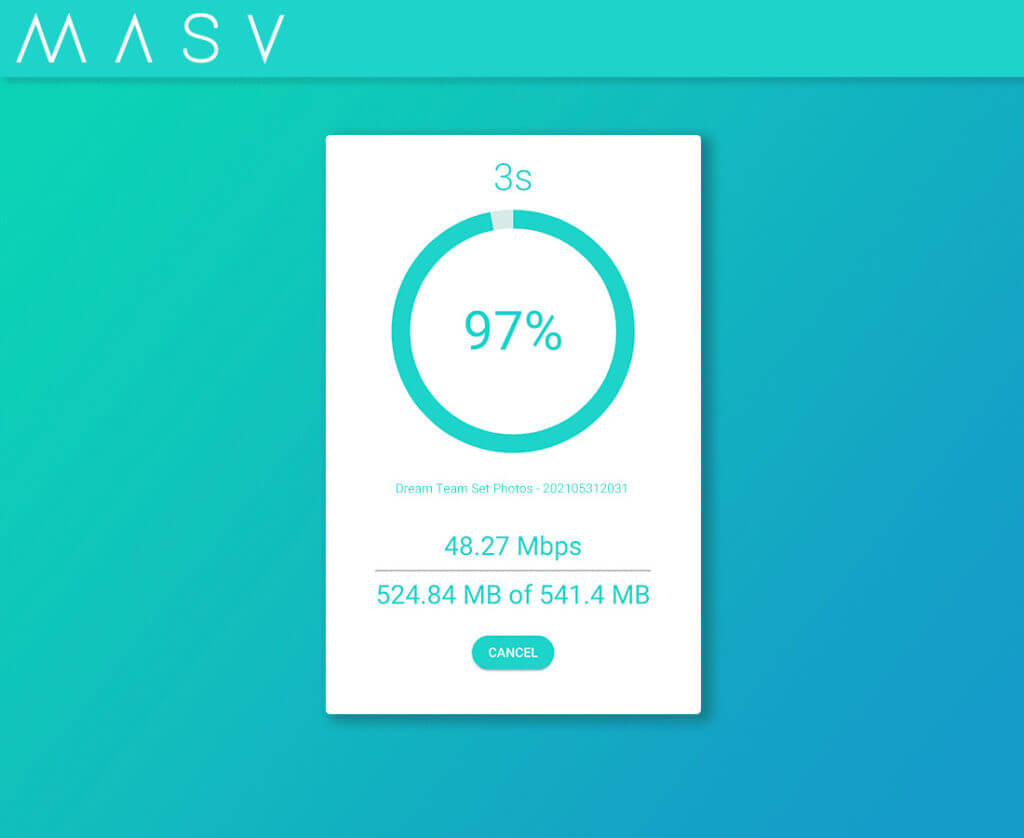
We are confident that MASV'south browser capabilities tin handle large file transfers. For the times it can't, due to native limitations of a browser, nosotros accept the MASV App for Windows, MacOS, and Linux. Your own defended highway running on Amazon'south AWS infrastructure.
- Triple your speed and send terabytes of data quickly.
- Interruption and resume downloads at your leisure.
- Avert the hassle of dealing with ZIP files with our direct-to-file arrangement structure.
- Fix automations for mundane tasks.
- Option back up where you lot left off afterwards a network crash.
Sign upward today for MASV and get 100 GB worth of data credits to transfer files over a browser or through the MASV app. While you're at it, read how Shadow Magic Studios uses MASV to transport huge, uncompressed video files from on-set DIT stations to editors working remotely.
"Nosotros test drove a bunch of unlike file transfer platforms, and MASV was the only i that ever worked without fail" – Jordan Maltby, Editor and CEO of Shadow Magic Studios
No Results Found
The page you requested could not be institute. Endeavor refining your search, or utilize the navigation above to locate the post.
Source: https://massive.io/how-to/how-to-upload-faster-in-a-browser-send-and-receive-large-files-quickly/
0 Response to "How to Upload a Zip File to the Internet"
Post a Comment