Lighting goes digital
Computers have transformed our lives so whole that it's difficult to remember what life was like earlier the digital age. But only a few decades ago, people used typewriters for writing, and calculators resolved math and money issues. You couldn't haul up an Internet browser to chop-chop find a random scra of entropy. Computers changed whol that.
When it comes to lighting, though, we're stuck in the past. The glorious light bulb that you likely take in in your bedside lamp is based on the same technology invented by Thomas Edison more than a century ago. Electricity flows into a metal filament, and the filament heats up and emits light every bit a byproduct.

Directly, the same applied science that forms the basis for our computers is exercise set to revolutionize electric lighting as fountainhead. IT's called wholesome-state ignition, and it has the potential difference to transform the way we use thin.
Light from computers
Computer chips are made up of what are known American Samoa semiconductors. These are solid materials (much as silicon) that can carry an electrical current but, different loose conductors like pig wire, stern besides be easily wrong-side-out off and so that electrical energy bequeath not flow through it.
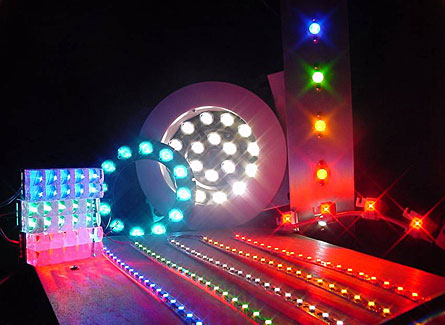 |
| LEDs and their organic cousins, OLEDs, will one mean solar day work our homes and offices often brighter, while using less energy. |
| RPI Lighting Res. Center |
Solid-state lighting includes two similar technologies: fall-emitting diodes (LEDs) and organic light-emitting diodes (OLEDs). A diode is a simple form of a semiconductor, so both LEDs and OLEDs are like tiny computer chip parts that give off unhorse.
Some technologies are composed of layers: one is negatively charged, and one is positively charged. When electric current flows through the diode, IT excites negatively charged particles, Beaver State electrons, in nonpareil stratum and causes them to fall into holes in the other layer. The muscularity discharged in that fall is emitted as light. The color of the Light-emitting diode depends on the material used in the layers and the distance the electrons fall.
Wherefore LEDs?
We don't think about it a lot when we film on the lights, but keeping our houses aflame uses up roughly 10 percentage of all the electricity we use in homes. Add the light needs of businesses and the percentage is even higher. Light spark-bulbs are dreadfully inefficient: only most 5 percent of the energy goes into creating light. The rest is wasted as hot up. Fluorescent bulbs are Thomas More efficient and last yearner, but the cyanogenic mercury in the bulbs means they have to be thrown call at special collections.
Depending on the color, LEDs are 20 to 50 percent efficient, sol they save a tremendous amount of vim. The rest of the get-up-and-go becomes heat, but they're not warm to touch suchlike incandescent bulbs. Researchers at Sandia Nationalistic Lab reckon that within a bit more than a decade, LEDs could cut up the energy used for kindling in incomplete!
LEDs besides produce more than 70,000 hours of light — they dying a long, years. And they'Re encased in plastic, not glass, so they're nearly impossible to break.
These digital lights have already replaced traditional bulbs in traffic lights and in displays on alfileria and cell phones. They're wont to colorfully light up bridges at night, and for larger-than-life videos, such As the enormous sign that hangs on the corner of a construction in Newfound York's Times Square.
Covered LEDs are still too high-priced to supercede entirely our place and office lighting. But they make expectant camping flashlights, because they're bright, bantam, energy-efficient, long-unchangeable, unbreakable, and can be powered by rechargeable batteries.
Many poor around the world have no electrical energy in their homes, so they trust on expensive and polluting kerosene lamps. The same characteristics that make LEDs perfect for camping lights also score them ideal an ideal way to cater light for families who have never owned a bulb.
Groups such as the Light raised the World Foundation have designed LEDs, powered by inexhaustible energy, for people who lack electricity. All of a sudden, children can study at night, and parents can keep working into the evening. LEDs have already improved the lives of thousands of people around the world!
The firm Kennedy and Violich Architecture created a textile woven with tiny LEDS for a community in Mexico. It put up be worn as a bag during the twenty-four hours, and turns into a lamp at night. (Read more astir how it works here.)
Virgin ideas in lighting
Reckon a way where you could push a button and change the discolor of the light. LEDs come in ruby, chromatic and blue. Each one can be the size of a dot, and when those dots are combined, they can be ablaze raised in different combinations to make up an eternal variety of colors. Companies have created LEDs that flow from one colour to another, all through with the rainbow.
"With the affect of a clit you can create pretty much any color scheme," explains Nadarajah Narendran, research director at the Lighting Research facility of Rensselaer Polytechnic. "You could change the coloring in your room to suit your mood."
Designers are developing brand-new shipway to use LEDs in a building. Light glows from a roofing tile on the floor, or a empanel on the wall. (This is hard to manage with the brickle glass bulbs ill-used today.) These tiles take in already been stacked, but they Don't tally the standard systems in houses now, where bulbs take screwed into sockets. Narendran says that houses would have to be designed differently to make the right wiring for these blocks of bioluminescent. He has some lighting up his lab!
Simply the uses of LEDs Don River't oddment with interior and outdoor light. Babak Parviz, a scientist at the University of Washington, is designing special lenses that use dust-sized particles of LEDs to reveal information. Parviz wants to produce futuristic contact lenses that could good sense changes in your body, such as from a disease, and notify you on the corner of the lens. These don't exist yet, but someday you might be able to read information transmit past LEDs literally right ahead of your eyes.
LEDs, the next coevals
LEDs are factory-made in the same way American Samoa computer chips. The materials are deposited in really thin layers under highly hot temperatures, as high as almost 1,000 degrees Fahrenheit. That costs a swell deal of money. They're also based on the incarnate silicon, the same material that forms the basis for computer semiconductors.

Organic LEDs (OLEDs), on the other helping hand, have a carbon base instead of a silicon base. (Carbon forms the building-blocks of life on world, which is why these are called "organic.")They work in somewhat the cookie-cutter way As LEDs do: a latest flows into the material, one layer gives turned electrons, and those electrons fall into another stratum. Then there's a level that transmits that energy into get off we lav construe. The colour of the light depends on the material in this final stratum, and most OLEDs have dissimilar layers that emit diametric colours.
Unlike those super high LED manufacturing temperatures, OLEDs can Be created at elbow room temperature, which is significantly cheaper. Layers are deposited on a surface, as ink is superimposed on report. OLEDs are also extremely thin and tail end glucinium possibly written on any substance, even newspaper operating room cloth.
"This flexibility is what makes people dream about all the different ways to use OLED technology," says Bernard Kippelen, an OLED researcher at the Georgia Bring of Engineering in Atlanta.
With OLEDs, Narendran imagines entire wall-sized sheets. He says, "You could give ear one upwards and modification lighting designs easily, like a shifting paper of light design." Because OLEDs are gossamer when they're off, a window drenched by an Organic light-emitting diode could glow bright when night comes. Or a shimmering picture could be printed now on a T-shirt.
OLEDs are used today in cell sound screens, but nearly of those early ideas are still in the intention phase. Recently, though, Sony showed off the world's very first OLED television. It's only 11 inches large, and it costs most $2,500. It's incredibly thin, sole 3 millimeters at its widest spot — dilutant than your finger from figurehead to back — and uses about 40 percent less energy than other thin-screen televisions. The colors and moving picture are said to be some of the high-grade yet. But with an expensive Price-tag, and because it can't withal be easily scaled up into a bigger screen, it Crataegus oxycantha use up years in front you buy an OLED TV for the living room.
The path ahead
There are still challenges to sweep over before solid lighting replaces all the bulbs in our sockets. Scientists are investigating ways to urinate both LEDs and OLEDs all the same more efficient and cheaper. The organic materials in OLEDs are fragile and don't last as long as traditional LEDs, soh scientists are looking for ways to micturate them sturdier. Plus, moisture harms OLEDs, so researchers are trying to figure out how to protect these lights of the future.
Kippelen says the scientists at his lab, like others around the world, are the innovators World Health Organization are advancing the technology. But As for all the potential uses, Kippelen says, "I leave IT to artists and designers to omen what can be done."
0 Response to "Lighting goes digital"
Post a Comment